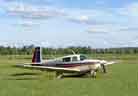
 This is the story of our trip to California for the American Yankee
Association's 2005 convention in Sacramento. Because of an
engine problem, we had to do some
airplane re-scheduling. As a result, we brought the only Mooney to a
Grumman Fly-in.
This is the story of our trip to California for the American Yankee
Association's 2005 convention in Sacramento. Because of an
engine problem, we had to do some
airplane re-scheduling. As a result, we brought the only Mooney to a
Grumman Fly-in.
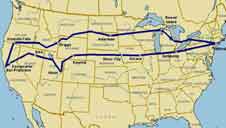 We visited these airports:
Sandusky, Ohio - fuel
Amana, Iowa - overnight
Sioux City, Iowa - overnight
Rawlins, Wyo. - overnight
Moab, Utah - overnight
Elko, Nev. - fuel
Sacramento, Calif. - the convention site
San Francisco, Calif. - overnight
Klamath Falls, Ore. - overnight
Driggs, Ida. - fuel
Aberdeen, S.D. - overnight
Beaver Island, Mich. - overnight
Milford, Conn. - home
 We began our trip in
Amana,
Iowa. Amana has it all: interstate highway,
railroad, a major river, and an airport less than half a mile from a good
motel. The
first picture
on this page was also taken at Amana's airport. The airstrip is between the
Iowa River and the train tracks, with the town of Amana lying just across the
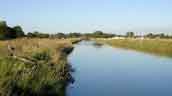
tracks. There is also a seven-mile-long raceway, which was important to all
seven of the Amana colonies. This canal provided power for several mills.
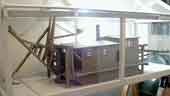
The historical museum has a replica of the dredge boat that was used to build
and maintain the canal.
We began our trip in
Amana,
Iowa. Amana has it all: interstate highway,
railroad, a major river, and an airport less than half a mile from a good
motel. The
first picture
on this page was also taken at Amana's airport. The airstrip is between the
Iowa River and the train tracks, with the town of Amana lying just across the
tracks. There is also a seven-mile-long raceway, which was important to all
seven of the Amana colonies. This canal provided power for several mills.
The historical museum has a replica of the dredge boat that was used to build
and maintain the canal.
 The Amanas were founded by a religious group from Germany who originally
settled near Buffalo, N.Y. From there they migrated to Amana in 1855, where
they established communes that persisted until 1932. In that year a
devastating explosion put an end to the communities' self-sufficiency. They had
no insurance, and could not absorb the enormous cost to rebuild their power
plant at the beginning of America's Great Depression. So they voted to join
the free enterprise system. The only remnants of the communal way of life
were the newly formed Amana Church Society and the Amana Society, Inc., which
oversees business and farming operations. The Amana Society still runs many
businesses in the colonies, but many more are independently owned and
operated.
The Amanas were founded by a religious group from Germany who originally
settled near Buffalo, N.Y. From there they migrated to Amana in 1855, where
they established communes that persisted until 1932. In that year a
devastating explosion put an end to the communities' self-sufficiency. They had
no insurance, and could not absorb the enormous cost to rebuild their power
plant at the beginning of America's Great Depression. So they voted to join
the free enterprise system. The only remnants of the communal way of life
were the newly formed Amana Church Society and the Amana Society, Inc., which
oversees business and farming operations. The Amana Society still runs many
businesses in the colonies, but many more are independently owned and
operated.
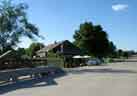
 There are several excellent restaurants ("good and plenty" style) within ten
minutes' walk of the airstrip. This would nominate Amana as an ideal spot
for a fly-in lunch. But the very first thing a pilot sees on the way into
town is this micro-brewery. Oh, well. The car in front belongs to a man who
knows a lot about breweries all over the world.
There are several excellent restaurants ("good and plenty" style) within ten
minutes' walk of the airstrip. This would nominate Amana as an ideal spot
for a fly-in lunch. But the very first thing a pilot sees on the way into
town is this micro-brewery. Oh, well. The car in front belongs to a man who
knows a lot about breweries all over the world.
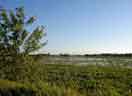 The Lily Lake has a practical purpose - it's a reservoir to maintain an even
water level in the raceway. It has also been a popular place for recreation
and reflection, especially in late July and early August,
when the lilies are in bloom. It's
between Amana and Middle Amana (background in this photo).
The Lily Lake has a practical purpose - it's a reservoir to maintain an even
water level in the raceway. It has also been a popular place for recreation
and reflection, especially in late July and early August,
when the lilies are in bloom. It's
between Amana and Middle Amana (background in this photo).
Amana houses.
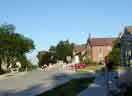
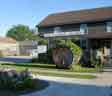
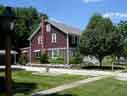
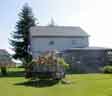
 One has a guard.
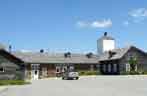
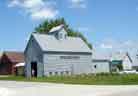 The original smokehouse is still used. It now includes a general store.
The visitors' center was once a corn crib.
The original smokehouse is still used. It now includes a general store.
The visitors' center was once a corn crib.
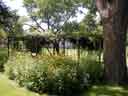
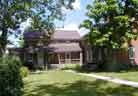
 The historical museum is part of the Amana Society property. Its exhibits
illustrate life in the commune, and show off the grape arbors that seem to be
everywhere in Amana. Men and women in the commune were given tickets that
they could redeem for wine, as a way of insuring that nobody drank too much.
Men were allowed twelve gallons per year; women, six.
The historical museum is part of the Amana Society property. Its exhibits
illustrate life in the commune, and show off the grape arbors that seem to be
everywhere in Amana. Men and women in the commune were given tickets that
they could redeem for wine, as a way of insuring that nobody drank too much.
Men were allowed twelve gallons per year; women, six.
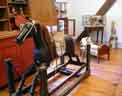
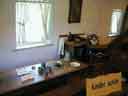 The Kinderschule was a nursery for children up to five years old - the
original day care center. This arrangement was needed because mothers had to
work in the community kitchens and gardens.
The Kinderschule was a nursery for children up to five years old - the
original day care center. This arrangement was needed because mothers had to
work in the community kitchens and gardens.
 Amana quilts are full cloth quilts, not patchwork squares. They are made of
one large piece of material covered in elaborate patterns of squares,
diamonds, flowers, and loops. The designs are traced onto the fabric from a
stencil. Often, one side is solid color and the other is a calico print.
The frame is large enough for six or more women to work together. Six women
working steadily can complete a regular-sized quilt in one day.
Amana quilts are full cloth quilts, not patchwork squares. They are made of
one large piece of material covered in elaborate patterns of squares,
diamonds, flowers, and loops. The designs are traced onto the fabric from a
stencil. Often, one side is solid color and the other is a calico print.
The frame is large enough for six or more women to work together. Six women
working steadily can complete a regular-sized quilt in one day.
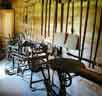
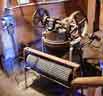
 Miscellaneous farm tools, including a machine to cut cabbage for sauerkraut
(second photo). The long-handled bucket is called a honeydipper. It's used
to clean privies.
Miscellaneous farm tools, including a machine to cut cabbage for sauerkraut
(second photo). The long-handled bucket is called a honeydipper. It's used
to clean privies.
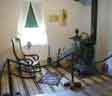

 The museum's Noe House gives the visitor a feel for domestic living in Amana
in the nineteenth century. All houses were similar in structure and
furnishings. The living room is about 15 feet square. The walls are all
painted in "Amana blue," a whitewash that was renewed every year. Carpets
were woven by the village carpet weaver, while smaller rugs and runners were
made by family members from cloth scraps.
Walnut and cherry furniture, clocks, and shelves,
were all made by local craftsmen. All of this, including the carpets, was
taken outside every year for spring cleaning.
The museum's Noe House gives the visitor a feel for domestic living in Amana
in the nineteenth century. All houses were similar in structure and
furnishings. The living room is about 15 feet square. The walls are all
painted in "Amana blue," a whitewash that was renewed every year. Carpets
were woven by the village carpet weaver, while smaller rugs and runners were
made by family members from cloth scraps.
Walnut and cherry furniture, clocks, and shelves,
were all made by local craftsmen. All of this, including the carpets, was
taken outside every year for spring cleaning.
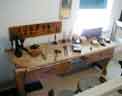 The cobbler's bench and tools
belonged to Charles Hergert of Middle Amana. When he closed up shop in the
1950s, he was the last working cobbler in the colonies.
The cobbler's bench and tools
belonged to Charles Hergert of Middle Amana. When he closed up shop in the
1950s, he was the last working cobbler in the colonies.
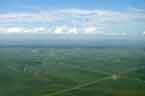 Navigating across Iowa by air is easy - the ground is your compass. If you
still use statute miles, you can get a pretty good idea about groundspeed,
too.
Navigating across Iowa by air is easy - the ground is your compass. If you
still use statute miles, you can get a pretty good idea about groundspeed,
too.
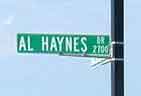 Our next stop was Sioux City, where we had an interest in the Lewis & Clark
Expedition. Sioux City is also famous among pilots as the site where
Captain Al Haynes brought
United's Flight 232
back to Earth in July 1989,
after a catastrophic, complete hydraulic failure. Having no conventional
flight controls, he steered by using differential thrust. By any
conventional estimates, this accident should have
been fatal to everyone on board. Because of the calm, clear thinking of
Capt. Haynes and his crew, and the unusual readiness of the people
of Sioux City, 184 people survived the crash. The people of Sioux City have
named a street for this extraordinary man.
Our next stop was Sioux City, where we had an interest in the Lewis & Clark
Expedition. Sioux City is also famous among pilots as the site where
Captain Al Haynes brought
United's Flight 232
back to Earth in July 1989,
after a catastrophic, complete hydraulic failure. Having no conventional
flight controls, he steered by using differential thrust. By any
conventional estimates, this accident should have
been fatal to everyone on board. Because of the calm, clear thinking of
Capt. Haynes and his crew, and the unusual readiness of the people
of Sioux City, 184 people survived the crash. The people of Sioux City have
named a street for this extraordinary man.
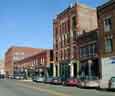
Walking around Sioux City, we encountered a headless woman and a bronze eagle. We also saw a tree that appears to be growing upside-down. The prairie dog guards a park on the Missouri River.


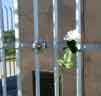
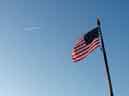 Sgt. Charles Floyd was the only member of Lewis and Clark's expedition who
did not return home alive. This monument is also Floyd's tomb, and people
still leave flowers for him two hundred years after he died.
The flag is the Star Spangled Banner (15 stars
and 15 stripes), which was our young country's flag during the expedition.
From a sign near the monument,
Sgt. Charles Floyd was the only member of Lewis and Clark's expedition who
did not return home alive. This monument is also Floyd's tomb, and people
still leave flowers for him two hundred years after he died.
The flag is the Star Spangled Banner (15 stars
and 15 stripes), which was our young country's flag during the expedition.
From a sign near the monument,
Sergeant Charles Floyd was one of the outstanding members of the Lewis &
Clark Expedition. Born in Jefferson County, Kentucky, sometime between the
years 1780 and 1785, his father and uncles served with George Rogers Clark
during the Revolutionary War. The younger Floyd, along with other handpicked
frontiersmen, joined Lewis & Clark at the Falls of the Ohio and was appointed
one of three sergeants for the expedition.
On August 19, 1804, after ninety-eight days of toil up the Missouri River,
Sergeant Floyd became violently ill. Captains Lewis and Clark diagnosed his
ailment as a "bilious colic." Modern medical authorities now believe it was
a complication of appendicitis, a condition without cure in Floyd's day. The
captains wrote: "...Serjeant Floyd as bad as he can be no pulse & nothing
will Stay a moment in his Stomach or bowels." Lewis and Clark could not save
him.
The boats pulled up to the east bank (at the southern edge of present Sioux
City, Iowa) just before noon on Monday, August 20, 1804. Floyd whispered, "I
am going away..." and died. He was carried by his comrades to the highest
bluff in the vicinity and buried with full honors of war, Capt. Lewis leading
the service. The spot was marked with a red cedar post carved with Floyd's
name and the date. Sergeant Floyd was the first US soldier to die west of
the Mississippi River and would be the only member of the expedition to lose
his life. The bluff and nearby stream were named in his memory.
Two years later, the returning expedition visited Floyd's Bluff. They found
the grave disturbed, perhaps by wolves. They refilled the grave and replaced
the marker. Nineteen days later, they reached St. Louis to a hero's welcome.
By 1857, the Missouri River had eroded Floyd's Bluff and nearly destroyed the
grave. Concerned citizens from the new town of Sioux City recovered Floyd's
remains and reburied them 200 yards east of the old site, away from the
river.
In 1894, the publication of Charles Floyd's recently discovered journal
revived interest in his gravesite. His remains were exhumed, reburied in
sturdy urns, and marked by a large marble slab. The Floyd Memorial
Association was formed, committed to erecting a permanent monument. Through
the efforts of Congressman George D. Perkins, former editor of the Sioux City
Journal, Congress appropriated $5000 and a like amount was granted by
the State of Iowa. These funds were matched by donations from private
citizens. The cornerstone was laid on August 20, 1900, the anniversary date
of Floyd's death.
Captain James C. Suskind and Captain Hiram M. Chittenden of the US Army Corps
of Engineers supervised the design and construction of the monument. The
remains of Sergeant Floyd were again unearthed and placed in the concrete
core of the lower courses of the monument, his fourth burial. The dedication
of the monument took place Memorial Day, 1901.

 Visitors to Sioux City's Lewis & Clark Interpretive Center are greeted by Pat
Kennedy's sculpture Spirit of Discovery, made in 2002. Left to right:
William Clark, Lewis's Newfoundland dog Seaman, and Meriwether Lewis.
The Garden of Discovery is outside the center. This commemorates one of the
expedition's less-celebrated purposes, to collect information about natural
history and botany from west of the Mississippi.
Visitors to Sioux City's Lewis & Clark Interpretive Center are greeted by Pat
Kennedy's sculpture Spirit of Discovery, made in 2002. Left to right:
William Clark, Lewis's Newfoundland dog Seaman, and Meriwether Lewis.
The Garden of Discovery is outside the center. This commemorates one of the
expedition's less-celebrated purposes, to collect information about natural
history and botany from west of the Mississippi.
Jefferson made sure Captain Lewis was trained to describe and collect the
plants he would encounter. Many of these plants would be new to science but
were known to the Indians. Although many of the specimens Lewis collected
were lost, more than two hundred survived the expedition, and have been kept
at the
Lewis & Clark Herbarium in Philadelphia.


 Inside the Interpretive Center: objects carried for trading, including
tobacco, thread and beads, and Jefferson's peace medallions; Indian
artifacts; and military equipment such as the men carried to the Pacific
Ocean two hundred years ago.
Inside the Interpretive Center: objects carried for trading, including
tobacco, thread and beads, and Jefferson's peace medallions; Indian
artifacts; and military equipment such as the men carried to the Pacific
Ocean two hundred years ago.
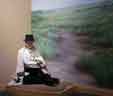
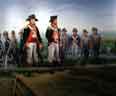

Animated displays recall Sgt. Floyd's last day and his funeral, which was
conducted by Lewis and Clark.
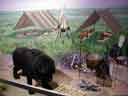
There's a robot for Seaman, too. A motion detector lets him bark whenever
visitors approach.
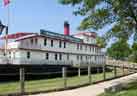
The Motor Vessel Sgt. Floyd was constructed at the Howard Shipyard of
Jeffersonville, Indiana, and launched on May 31, 1932. The Floyd has
been used by the Missouri Division of the US Army Corps of Engineers as a
Survey and Inspection vessel. During its active duty time, the Floyd
spent many years following the water trail of the Lewis & Clark Expedition.
The Sgt. Floyd is now a tourism center and river museum that contains
displays regarding the Lewis & Clark Expedition as well as demonstrating the
history and use of the Missouri River through the years.

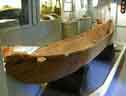
 This is a model of the keelboat Rocky Mountains, which was used in
William Ashley's 1823 expedition.
This is a model of the keelboat Rocky Mountains, which was used in
William Ashley's 1823 expedition.
On March 10, 1823, a brigade of over 100 fur traders, trappers and hunters
under the command of Gen. William Ashley of the Rocky Mountain Fur Company
departed St. Louis for the trapping and trading territories of the Upper
Missouri River. Passing Floyd's Bluff in early April, the two-keelboat
flotilla proceeded without incident into the Arikara Indian villages of North
Dakota. There, at 3 AM on June 1, 1823, after a day of peaceful trading, the
Arikara launched a night attack on the sleeping boatmen. Fifteen of Ashley's
men were killed, many more wounded, and the expedition driven back in
disarray. Leaving the survivors and the keelboat Rocky Mountains on
an island downstream from the village, Ashley and the keelboat
Yellowstone Packet retreated over 400 miles downstream to the US Army
post of Ft. Atkinson, near present-day Omaha. The resulting 400-man
campaign of American troops under the command of Col. Henry Atkinson against
the Arikara, although near bloodless in result, became in 1823 the first
organized march of United States soldiers into the Upper Missouri River
territory since the Lewis & Clark Expedition of 1804.
This model represents a typical Upper Missouri keelboat of the 1820-1830
decade, being double-ended and nearly flat of bottom. Length represented is
seventy feet with a beam of twelve feet. Materials used in the construction
were basswood, aspen, red gum, and birch, with cherry pegging. Hardware is
brass.
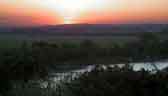
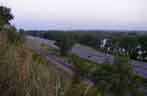 Standing on Floyd's Bluff in Iowa, watching the sun set over Nebraska, the
observer can see four important modes of transportation: the Missouri River,
the railroad, interstate highway, and the Sioux City airport. The airport
isn't exactly obvious in the photo, but its beacon is visible about 15% of
the way in from the right edge, on the horizon.
Standing on Floyd's Bluff in Iowa, watching the sun set over Nebraska, the
observer can see four important modes of transportation: the Missouri River,
the railroad, interstate highway, and the Sioux City airport. The airport
isn't exactly obvious in the photo, but its beacon is visible about 15% of
the way in from the right edge, on the horizon.
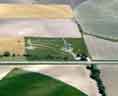 Our short-term goal was to reach Moab, Utah, but this requires crossing the
Rocky Mountains. It's better to do that flight early in the morning, so we
wanted to spend the night somewhere just east of the Rockies. We chose Rawlins,
Wyoming. On the way there from Sioux City, we flew over Alliance, Nebraska,
home of
Carhenge. Carhenge is a faithful
replica of England's Stonehenge; but it's made
of cars, not stones. The cars are welded together and painted grey. The
heelstone is a 1962 Cadillac. It was built by Jim Reinders (who is also
responsible for the Tar Cars in the parking lot of Hamden Plaza in
Connecticut) and was dedicated at the summer solstice, 1987.
Our short-term goal was to reach Moab, Utah, but this requires crossing the
Rocky Mountains. It's better to do that flight early in the morning, so we
wanted to spend the night somewhere just east of the Rockies. We chose Rawlins,
Wyoming. On the way there from Sioux City, we flew over Alliance, Nebraska,
home of
Carhenge. Carhenge is a faithful
replica of England's Stonehenge; but it's made
of cars, not stones. The cars are welded together and painted grey. The
heelstone is a 1962 Cadillac. It was built by Jim Reinders (who is also
responsible for the Tar Cars in the parking lot of Hamden Plaza in
Connecticut) and was dedicated at the summer solstice, 1987.
At first the people of Alliance didn't like their new landmark very much, but
they warmed up to it after the tourists started to arrive and spend.
on to Rawlins
Amana
Sioux City
Rawlins
Rockies
Moab
Canyonlands
Arches
Salt Lake
Sutter Creek
Big Trees
Sacramento
Convention
Lava Beds
Crater Lake
Beaver Island
Home